

Dear Home Ec 101,
I was hoping you might be able to explain how a water bath thaws out a chicken faster than sitting on the counter when the water is colder. Also, why is it safer ? It seems to me the water would just be a good place for germs to grow.
Signed,
Perplexed in Perkaise, PA
Dear Perplexed in Perkaise, PA,
What you are asking about is called heat transference, which is the way heat gets from one thing to another. Heat always moves from warmer things to cooler things. This is phenomenon is described by the Second Law of Thermodynamics. In any system, in this case, chicken and the surrounding air or water, the energy involved is trying to reach a state of equilibrium.
Waterbath Food Safety 101
When a cold tray of chicken is sitting at room temperature on the counter, room temperature molecules, like carbon dioxide, bounce off the package and transfer a little of their heat to the chicken. Remember, atoms and molecules as gases are very far apart (relatively people, relatively), so they can only interact so much.
When the tray of chicken is immersed in cool water, lots of molecules interact with the package of chicken transferring their heat. Even if your groundwater is pretty chilly, the sheer number of interactions speeds up the process.
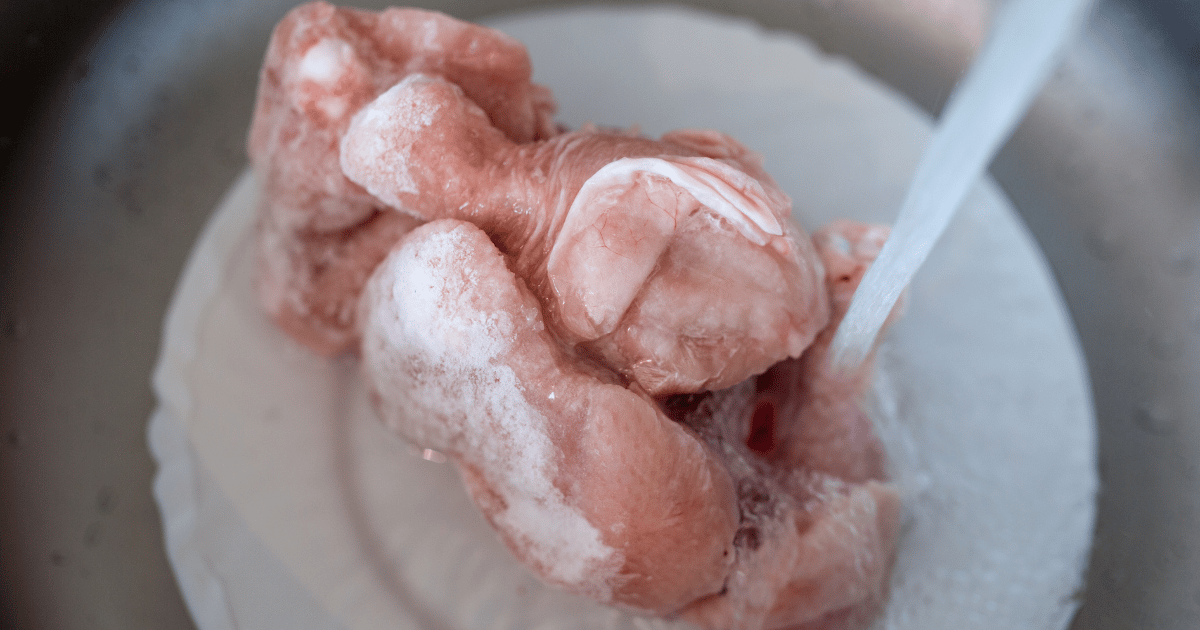
Now, why doesn’t the water turn into a giant bacteria farm? The short answer is, it does. However, the proper way to thaw chicken in a water bath is to either change the water every twenty minutes or to trickle water into the water bath allowing the excess water to spill out. In the first scenario, bacteria doesn’t have time to grow to dangerous levels, and in the second the water is continuously being replaced, flushing away bacteria.
Make sense?
*Edit* The chicken should be in leak-proof packaging. Waterlogged chicken is nasty.
Send your household questions to helpme@home-ec101.com.

one thing that wasn’t mentiones is that you need to leave the chicken/turkey in its packaging to do the running water thing.
we had a kitchen sink once where the divider between the sinks was shorter then the sides so — the night before thanksgiving finding that the turkey was still in the freezer, it went in one sink with the drain-plug in and we started the water at a trickle waited to make sure that when the sink was full the water would drain to the other sink – w/no drain-plug and not over flow — the next morning the turkey was fully thawed 🙂
yes, remember to leave it in the packaging!
I had a group of kids in school who took salmon out of the package to thaw it, and it actually ruined the salmon, as it destroyed it as the water ran (that and i think they had the water running too fast).
I was told NOT to immerse the chicken (pork chops, hamburger, etc.) in hot water because that actually starts “cooking” it.
Was that just a tale my old wife told me?
Cool water is best. Hot water will begin to change the protein structure of the outermost layers of meat. It probably wouldn’t COOK it, but it’d start it on its way and it certainly wouldn’t be enough to start the maillard reaction which is where you get all the tasty goodness of searing.
Oh Crud, I could have used this post this morning… I hope my chicken is not too water logged… maybe the grill will dry it back out. Lets hope so.
I don’t really get this. I do use this method, but it doesn’t make sense to me that you’re getting rid of the bacteria by keeping it running or changing the water when the chicken is in a package. How is it getting rid of it if it’s all sealed up?
The packaging is rarely impervious. Pin holes develop during shipment and handling. While the package may keep most of the water / chicken juices in or out there is frequently some exchange. Also of concern is cross contamination.