
 Heather says:
Nothing says weekend indulgence like a pancake and nothing tastes better than a pancake served up by someone else. But what happens when you’ve moved out and a weekly trip to IHOP just isn’t in the budget? You learn how to do it yourself. This recipe is simple and a great starting point for many variations.
I’ve said before that cooking is chemistry; pancakes are a perfect example. Light, fluffy pancakes are the combination of an acid base reaction and the proper addition of heat. Too hot and the outside of the pancake burns before the batter can set. Too cool and the bubbles will escape before the batter cooks enough to trap the air.
This recipe yields 21 5″ pancakes. If you use full fat buttermilk, you may have slightly fewer as this yields a thicker batter.

Buttermilk Pancakes
- 4 TBSP butter, melted
- 2 eggs brought to room temperature
- 3 cups buttermilk (full fat is best, but fat free works do NOT substitute milk with lemon or vinegar)
- 2 tsp vanilla
- 1 tsp salt
- 1 tsp baking soda
- 1 tsp baking powder
- 5 TBSP sugar (less if adding something sweet to the batter such as bananas or chocolate chips)
- 2 cups all purpose (plain) flour
- *optional* vegetable oil for greasing a regular, not nonstick skillet
Measure the liquid ingredients into a large bowl and set them aside. This gives the liquids a chance to come to room temperature without spending too long in the bacterial “danger zone.”
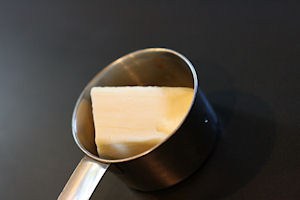 I melt my butter in a metal measuring cup on the griddle as it preheats. I do this mostly out of laziness. The speed of chemical reactions is dependent on the temperature at which they occur. Cold ingredients cause a slow reaction. Room temperature ingredients yield larger bubbles that are trapped by the batter in the cooking process.

Whisk together the dry ingredients.
Heat your pan.
If you have a nonstick, electric griddle, I find it unnecessary to grease the surface. (Unless you’ve had trouble with items sticking) Heat the griddle to 300. If using a heavy skillet, drizzle a small amount of vegetable oil into the pan, then use a paper towel to spread it in a thin layer. Too much oil makes the first batch of pancakes gross. If you are using the stove, heat the pan on low. Hotter does not equal better, be patient and allow your pan to heat before cooking the pancakes.
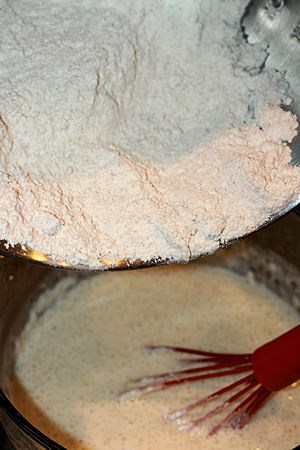 While the pan heats, pour half the dry ingredients into the wet. Whisk thoroughly, breaking up any lumps. Add the second half of the dry ingredients to the batter and stir it just enough to bring it together. If you overstir, you’ll release the air bubbles that are the point of this whole project. Set the batter aside and find your 1/3 measuring cup.
Giving the batter a couple minutes to rest allows the reaction to get underway.
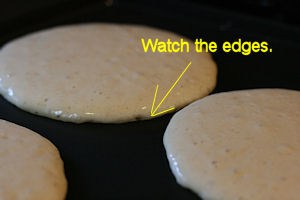 Now for the magic. Pour the batter by 1/3 cup fulls into your hot skillet. Don’t get anxious, watch the edge of the pancakes.
 When the very edge of the pancake has set and there are bubbles across the entire cake, use a spatula and flip the pancake. This takes a little practice. Slide the spatula completely under the cake before flipping. If you only grab an edge you increase your chance of dropping the cake which is disappointing.
 Flip the pancake quickly. And allow to cook for another minute and a half to two minutes, depending on how done you like your pancakes.
If you’re like me and enjoy bacon with your pancakes, the already hot, but not on oven is a perfect place to store the pancakes until it is time to serve everyone.
Since I highly recommend room temperature batter, don’t save the leftovers for another day. Finish cooking the batch if there are too many for your needs. Place the leftovers in a single layer on a sheet pan or plate and place in the freezer. Once frozen, place in a zippered freezer bag and store in the freezer. They can be thawed in a toaster or the microwave for a quick weekday treat.
Enjoy!

They look great. I enjoy ones like that at my local IHOP. LOL I use my father’s recipe for pancakes they have about 1/2 the ingredients and give you a thinner, crispier pancake, which is what I grew up on. And now my kids are growing up on them also.
yummy yummy yummy!
i love buttermilk pancakes, with brown sugar or white sugar 😉
I read in Cook’s magazine to substitute milk plus lemon juice for the buttermilk (For each cup of buttermilk, pour 1 TB lemon juice in a measuring cup and fill up to the 1 cup mark with milk. Allow to sit for five minutes). I like this better because i don’t always have buttermilk on hand and milk is a lot cheaper than buttermilk.
I make a BIG batch of pancakes and waffles at the same time. Like 8 cups of flour, 8 eggs, two sticks of butter and 6 cups of milk. I freeze the leftovers and my daughters have them for breakfast. I put them in plastic containers and put parchment paper between them to keep them from sticking together.
Presto makes a very cheap electric griddle called Tilt-n-Drain that I can get 9 small pancakes on at once. I picked one up at Walmart after looking at some much more expensive models and this works very well. There are some spots on it that cook faster than others, but I work around it.
That is an excellent substitute. For this recipe, I would increase the flour if you use the substitute. Buttermilk is typically much thicker than even whole milk and will yield thinner pancakes without an adjustment in the ratio. However, the acidity us sufficient to drive the reaction.
How much would you increase the flour if substituting milk+lemon for buttermilk in the pancakes?
Probably by several tablespoons.
These look amazing! My pancakes tend to come out thin so I’m trying this for thicker ones. Thank you!
I’ve made pancakes a lot more often since I bought my huge electric griddle (the large size Tilt ‘n Drain). Prior to that, any attempt to do them in a skillet ended up with the first few being inedible. Sometimes, I just ended up with scrambled pancakes. Tasty, but not too pleasant on the plate. I usually cook the bacon first, then keep it warm in the oven while I make the pancakes. I use the bacon grease on the griddle for the pancakes Makes ’em yummier.
This griddle has made a huge difference. I’ve used it for grilled cheese, fried eggplant, grilled zucchini, hamburgers, eggs, bacon, sausage, french toast and pancakes. Best $30 I ever spent on something for the kitchen.
I gave Tim a griddle for Christmas. I think it was $40ish but it disassembles and the griddle can be flipped to use a grill. Cooking for 5 or 6, we’ve fallen in love with it. Grilled cheese and quesadillas are now a cinch to mass produce. It’s definitely an appliance I recommend to anyone who cooks for several people.
Is this the electric ones you’re speaking of? We have one of those griddles you can stick over 2 burners.
Yes, our range is a smooth top. Granted, I haven’t specifically looked, but I’ve never seen a griddle made for flat tops.
Thanks for the recipe. I will try this sometime soon.
I bet the combo of the brown sugar and vanilla was super-yum! We use whole wheat pancake mix/flour, but you have me yearning to putting some vanilla and brown sugar into mine to make mine yummier! I’m such a fall-buff, all those scents and smells – I religiously use cinnamon, nutmeg and cloves in my pancakes. But vanilla and brown sugar? Magical.
I tried this recipe tonight. Very tasty but have a question. How come the pancakes came out the size of lunch plate?
Please put some blue berries in my pancakes. Thanks! Oh, and can you bring them over Friday morning about 8? I am too lazy to get up and cook them myself.
What if my wife and I ran out for errands and forgot to put our pancake batter back in the fridge??? We came back 6 hours later, and put in the fridge. Would we be dumb to prepare more pancakes with the leftover batter?
I couldn't safely recommend that course of action.
I was looking for a good Buttermilk Pancake receipt – my mother told me that she used to make it a lot when I was a child but she has forgotten how to do it. Gone try this tomorrow and see how it will taste.
I LOVE your site! I found you via another great site like yours called @www.domesticsquarepeg.com and this was JUST the information I was looking for– how to freeze pancakes. By the way, your two sites complement each other well!
Thanks for all your great information!
I LOVE your site! I found you via another great site like yours called @www.domesticsquarepeg.com and this was JUST the information I was looking for– how to freeze pancakes. By the way, your two sites complement each other well!
Thanks for all your great information!
I would like to suggest a few improvements. Over mixing the batter not only develops excessive glutens (chewy pancakes) it also accelerates the development and loss of CO2 bubbles. All of the gas you allow to escape in stirring/mixing could have made your pancakes fluffy and light. It is much better to use a spoon and beat the mix about 10 strokes, or just to the point where it is blended but lumps remain. Due to Fick’s law of diffusion, your flour lumps will “dissolve” if your batter is viscous and heat is applied. Timing is critical. When using baking soda/buttermilk to produce CO2 your batter needs to sit for a minute or so until you see good bubble development.
Flicks law. who makes this stuff up? Person named Flick i guess.